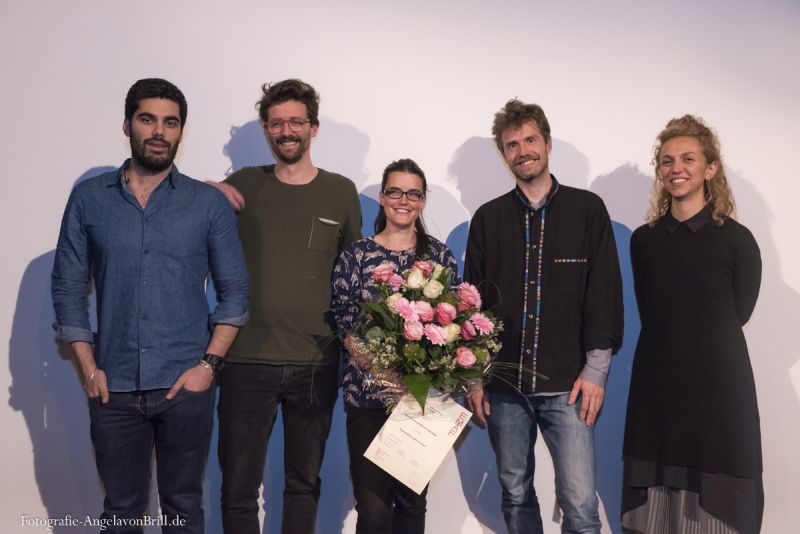
EMAF 2017 – the award ceremony
Elise Florenty and Marcel Türkowsky win EMAF Award
Three awards were presented at the evening award ceremony of the 30th European Media Art Festival. The EMAF Award worth €3,000 went to the artistic duo Elise Florenty&Marcel Türkowsky for their trend-setting work in media art. Lawrence Abu Hamdan won the “Dialogpreis” of the German Ministry of Foreign Affairs for the promotion of intercultural exchange. The EMAF Media Art Award of the German Film Critics was won by Philip Widmann for his outstanding German work.
Two juries spent the last few days viewing the nominated works. The international jury – comprising Kabir Mehta (producer and director, Delhi), Federica Patti (freelance curator, Bologna) and Ulrich Ziemons (curator and film scholar, Berlin) – presented not only the EMAF Award, but also the “Dialogpreis” of the German Ministry of Foreign Affairs, worth €2,000.
Lawrence Abu Hamdan won the award for his film “Rubber Coated Steel”. In his work, the sound artist Abu Hamdan investigates an incident that occurred in front of a prison on the occupied West Bank in which two unarmed youths were shot by an Israeli soldier during protests. With his audio-ballistic analysis of the recorded gunshots, Abu Hamdan provided pivotal evidence that the soldier did indeed use live ammunition and not “just” rubber bullets, as he claimed. “A straightforward inquiry into a highly loaded conflict, this film provides a powerful statement against systemic violence and the silencing mechanisms of legal discourse,” stated the jury. They added that by staging a forensic investigation as a visceral cinematic experience, it challenges conceptions of visual storytelling as well as the very systems called upon to provide truth and justice.
Elise Florenty and Marcel Türkowsky won the EMAF Award a second time, after having already scooped the prize in 2014. This year, the artists inspired the jury with their work “Conversation with a Cactus”. The story tells of Mei, a 30-year-old woman from Tokyo, who sends a message to her friend Toshi in Hamburg, telling him about haiku, strange recollections from her youth, and the last muggy summer night. She combines her dream-like journey with various statements about the legendary 1970s Hashimoto experiment. The objective was to show that plants have a conscience, enabling them to be used in future in the investigation of crimes. “Part media history, part ghost story, the film interweaves science and mythology and leads us to a space beyond comprehension and reason,” remarked the jury. Taking clues from Japanese popular culture and tradition, the jury continued, it presents itself as a welcoming labyrinth of moods and experiences in which we gladly lose ourselves.
The German jury comprised Ekkehard Knörer (film critic and publicist, Berlin), Conny E. Voester (freelance curator and project manager, Berlin/Basel) and Insa Wiese (Head of the International Short Film Week Regensburg). The three jury members conferred the Media Art Award of the German Film Critics (VDFK) on Philip Widmann for his film “Das Gestell”.
In this work, a German filmmaker goes to Kyoto and encounters a group of Japanese philosophers grappling with Heidegger’s philosophy of the technological world. He begins to get interested in Heidegger, making 16mm recordings of water and woods, the city and its people, and getting into contact with Heidegger’s biography and his philosophy. The jury was convinced that Widmann gives very smart, intricate and indirect form to an encounter of words and worlds, images and sounds. “The filmmaker’s and the philosophers’ notes on history, but also Heidegger’s thought are present only in written form, as subtitles – which makes the one moment when the group searches for a correct translation of Heidegger’s language the more salient.”
Before presenting the award, worth €1,000, Conny E. Voester read out a statement by the German jury. She reminded the audience of the fate of her colleagues, who are not only impeded in their work, but also imprisoned or even face death threats, as is the case in Turkey at present. “We continue to call strongly for the release of Deniz Yücel and all other imprisoned journalists,” stated Voester to applause at the award ceremony of the 30th European Media Art Festival in Osnabrück.